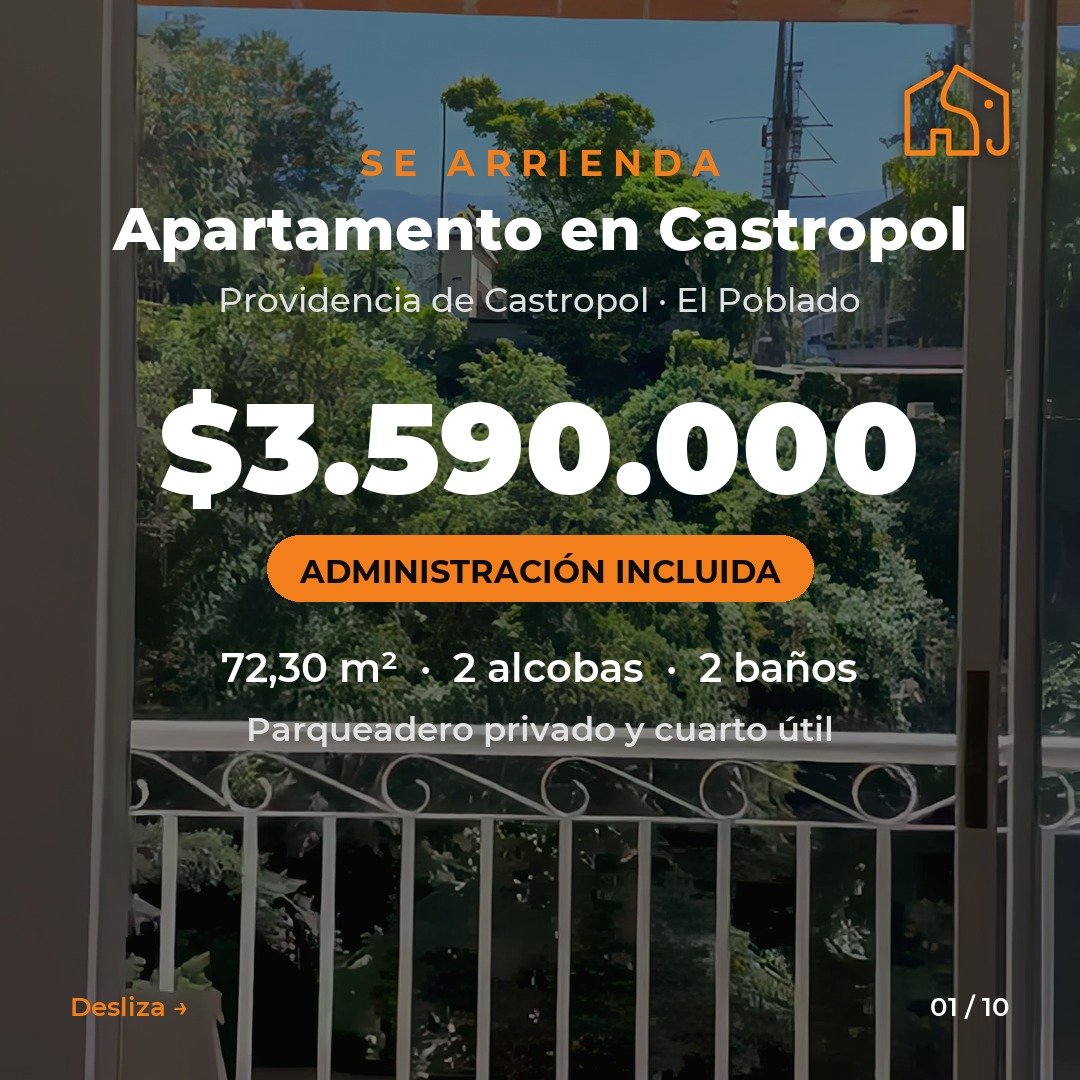
Long-term rentalPets allowed
COP 3,590,000 / month
Apartamento en arriendo en Castropol, El Poblado · 2 alcobas, balcón y vista verde
Apartment · El Poblado
- 2Bedrooms
- 2Bathrooms
- 65 m²
The city's most international district, and its most expensive. What estrato 6, building fees and a foreign buyer's paperwork really cost.
El Poblado is Comuna 14, on the eastern slope of the valley, and it is the most expensive and most international part of Medellin. It is also the hilliest. The Poblado metro station sits on Line A at the bottom, down on Las Vegas, and a great deal of the neighbourhood is a steep climb above it — a distinction that matters enormously in practice and disappears entirely on a map.
Within it are distinct areas: Provenza and the streets around Parque Lleras, dense and loud; Las Lomas and the upper reaches, quieter, greener and car-dependent; the corridor along Avenida El Poblado, convenient and congested.
This is the zone with the most English-language demand in the city, and the searches split cleanly in two: “apartments for rent el poblado medellin” and “living in el poblado medellin” on one side, “cost of living in el poblado medellin” and “apartments for sale medellin el poblado” on the other. People are deciding whether to come, and then deciding whether to buy.
It is worth being direct about why El Poblado dominates those searches. It is where the infrastructure for arriving without Spanish already exists — serviced buildings, English-speaking agencies, coworking, international schools nearby. That convenience is real, and it is priced in.
El Poblado is overwhelmingly estrato 6, the top of the Colombian socioeconomic classification. Estrato is not a status label; it is a tariff bracket. The upper strata pay a surcharge on utilities which subsidises the lower ones, and the classification also feeds the annual property tax.
So the same shower, in the same city, costs more here than in Laureles. When you compare a flat in El Poblado with one across the river, the rent difference understates the real difference in monthly cost.
Administración. In El Poblado this is the big one. Towers here compete on amenities — pools, gyms, squash courts, lounges, 24-hour reception, visitor parking — and every one of them is funded by the monthly building fee. In a heavily amenitised tower the administración can be a serious fraction of the rent. It is charged on top, it is non-negotiable, and it is the number most often missing from an international listing. Ask for it in writing.
Utilities. Estrato 6 rates, as above.
Getting around. If you take a flat high on the hill, budget for daily taxis or a car and parking. Walking down is pleasant; walking back up, with shopping, at 1,500 m, is not a plan.
The climate is mild all year, which is the city's best-known feature and the reason nothing has heating or cooling. Less known: the eastern slope catches a lot of cloud, and lower-floor flats in dense pockets like Provenza can get very little direct sun.
Humidity does the rest. Check the orientation, check the bedroom walls and the inside of the wardrobes, and prefer a flat that gets sun for part of the day. In a tower, also ask which floor the noise from the street reaches — in the Lleras area it travels further up than people expect.
Residential leases fall under Ley 820 de 2003. The useful part: twelve-month contracts are standard, and the annual increase cannot exceed the previous year's consumer price index. A long contract with a capped increase is a genuinely good instrument for a tenant.
The difficult part: Colombia does not generally run on large security deposits. A landlord expects a codeudor — a local co-signer who owns property — or an insurer's rental guarantee policy. A new arrival has neither, and no Colombian credit file.
El Poblado is where the market has adapted most to that gap, which is both the attraction and the trap. An entire furnished, flexible, English-speaking rental sector exists here precisely because it bypasses the codeudor problem, and it charges a substantial premium for doing so. If you are staying a year, it is usually worth pushing for a conventional contract with a guarantee policy or several months prepaid, and paying considerably less.
Two things people get wrong, in opposite directions.
It is more straightforward than expected: you do not need residency or a Colombian ID to buy property. The purchase is executed as a public deed before a notary and then registered at the public instruments registry, and that registration is what gives you title.
It is also more procedural than expected. Notarial fees, the beneficencia charge and registration costs are real and are customarily split in a particular way between buyer and seller — agree who pays what explicitly. And if you intend to take the proceeds out of the country when you eventually sell, the foreign investment should be registered with the Banco de la Republica at the time you bring the money in. Doing that correctly at the start is simple; reconstructing it years later is not.
Have an independent lawyer check the title, the building's financial position and whether there are outstanding administración debts attached to the unit. Unpaid building fees follow the property.
El Poblado is the epicentre of this question and the place where the answer has moved most.
Many buildings' bylaws — the “reglamento de propiedad horizontal” — prohibit short-term tourist letting, and building assemblies here have been voting to tighten those rules, not relax them. The bylaws bind the owner whatever the listings in the same tower appear to show.
Separately, tourist accommodation is a registered activity nationally, with the tax treatment that implies. If the investment case rests on nightly rates, verify the building's rules and the registration requirements before signing. Buildings in this neighbourhood have enforced against owners.
Whether it is expensive: yes, by Colombian standards, markedly, and the gap grows once administración and estrato 6 utilities are counted. Whether you can live without Spanish: here, more than anywhere else in the city, yes. Whether you need a car: it depends entirely on how high up you are. Whether it is safe: it is a well-policed, affluent district with the pickpocketing and drink-spiking problems that follow concentrated nightlife, centred tightly on the Lleras area.
Someone who wants a short, soft landing — arriving without Spanish, needing a serviced flat and an English-speaking agent, staying three to six months. Also someone buying for the valley view and the resale liquidity, which this zone has more of than any other.
Someone staying two years and watching costs is usually better served across the river.